
AI Estimating reads your floor plan and generates a structured cost estimate, line by line, category by category. Every estimate includes confidence bands and requires your sign-off before it flows anywhere near a buyer.
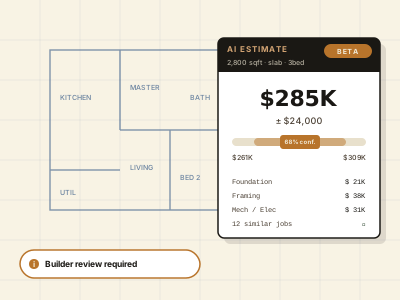
Every line ships with a confidence band, high, medium, or low, so you know exactly where to look before you approve.
Estimates are generated by AI trained on construction cost data and your own historical jobs. They are a starting point for your review, not a final price. Every estimate clearly shows confidence bands, and no estimate can flow to a buyer without a builder explicitly approving it. As you use it, accuracy improves on your specific plan types and market.
Pricing a new plan from scratch means pulling comparable jobs from memory or from a spreadsheet nobody's updated recently, then building line items by hand. That's 1-3 hours before you even know whether the numbers are in the ballpark.
The AI reads the plan. You review and adjust. Nothing moves to a buyer without your approval.
Upload the floor plan PDF for the lot. AI Estimating reads room dimensions, ceiling heights, foundation type, and plan complexity to build the initial estimate structure.
Claude analyzes the plan and generates a line-item estimate categorized by trade: site, foundation, framing, mechanical, finish. Each line includes a confidence band, high, medium, or low.
Every estimate lands in your review queue, never in the job automatically. Edit any line, override any number, flag any low-confidence item for manual research. The AI's work is your starting point.
When you're satisfied, approve the estimate. It flows into the Job Start Sheet as a starting draft. Your approval is logged, the AI's version and your final version are both stored.
Confidence bands are shown on every line. Low-confidence lines flag items that need a manual call, the AI is telling you where it's uncertain.
AI Estimating is designed so the AI's job is to save you time, not to replace your judgment on what a job actually costs.
High, medium, or low confidence shown on every line item. Low-confidence lines are flagged for manual review, the AI is transparent about where it's guessing.
No AI estimate flows anywhere without explicit builder approval. Period. The review step isn't optional and can't be bypassed, not even by admins.
As you approve and adjust estimates, Lotwright records the delta between AI and final. Over time, estimates on your specific plan types and market become more accurate.
The same Anthropic Claude that powers voice walk extraction, applied to cost estimation with purpose-built guardrails.
Claude analyzes floor plan layout, dimensions, and complexity to generate structured cost estimates. The same AI powering voice walks, applied to a different problem.
AI estimating runs on your org's monthly AI budget. A budget cap prevents runaway spend. You control the ceiling, usage details visible in Settings → AI Budget.
Your cost history, approved estimates, and adjustments are private to your org. They're used to improve accuracy for your account, never shared with other builders on the platform.
The AI's original estimate and your final approved version are both stored permanently. Track how estimates change over time, and how your AI accuracy improves as it learns.
During the beta, Lotwright tracks estimate accuracy (AI estimate vs. actual job cost) to improve the model. You can see your personal accuracy stats in the AI settings panel.
A typical estimate generates in 2-4 minutes. Compare to 1-3 hours of manual line-item pricing. The AI handles the first draft; you handle the judgment.
Included with Standard tier ($199/mo). AI Beta opt-in required. 30-day free trial, no charge until trial ends.
Apply for Beta →